
 Published: 2026-09-01
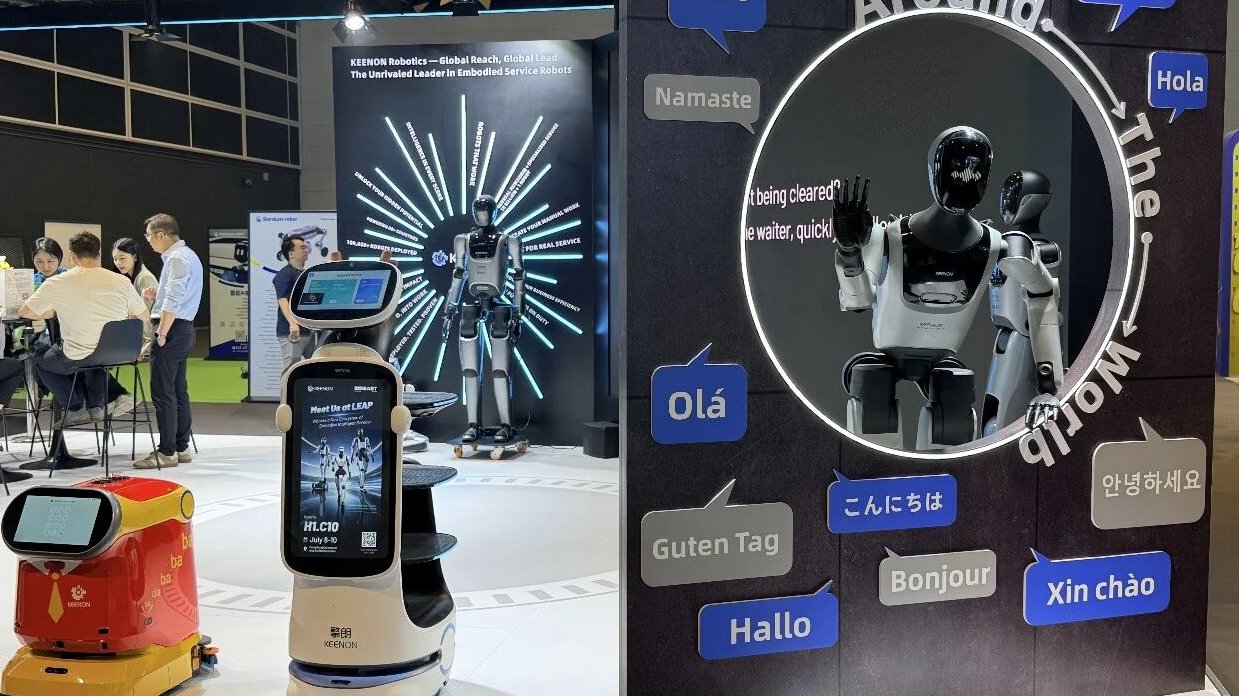
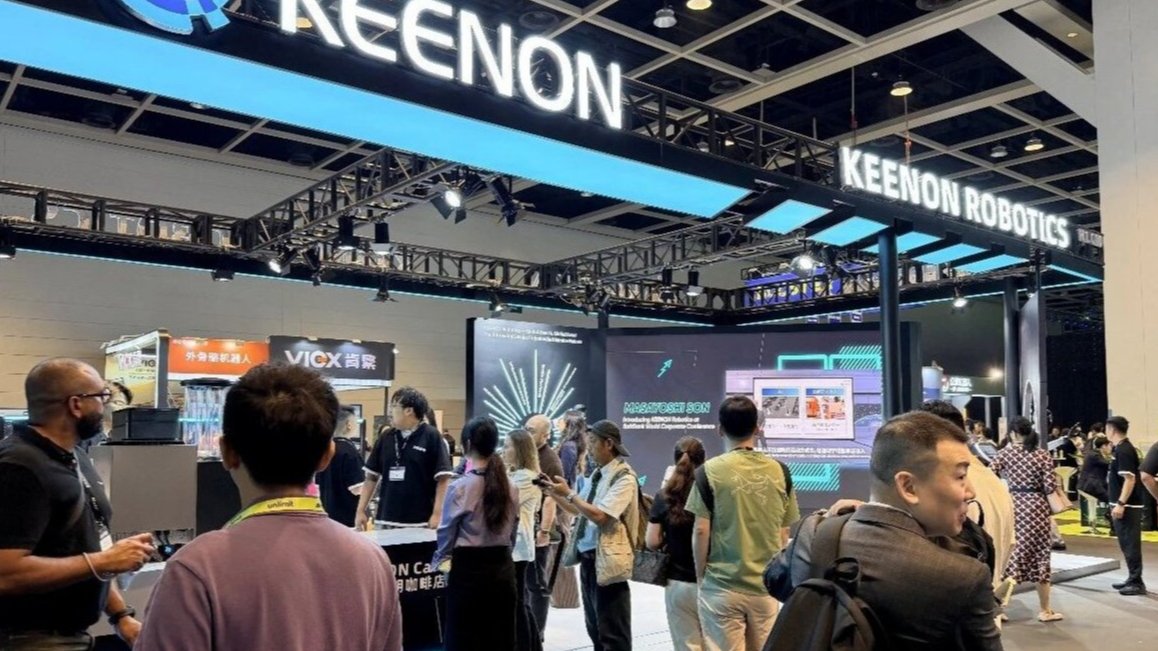
The 2026 World Robot Conference (WRC 2026) was held from August 19 to 23. KEENON Robotics showcased its XMAN series of humanoid robots alongside a comprehensive lineup of delivery and cleaning robots. At its booth, the company created an "Embodied Community" featuring four real-world service scenarios: a laundry room, coffee kiosk, dessert shop, and retail store. The demonstrations were powered by KOM 3.0, which KEENON describes as the world’s first service-industry VLA architecture to integrate a latent-space world model. During the demonstrations, the robots completed designated long-horizon tasks autonomously from end to end, without teleoperation. The showcase highlighted the industrial-scale application of embodied intelligence across the full service workflow, from perception and understanding to decision-making and execution.
The core breakthrough of KOM 3.0 lies in giving robots the ability to anticipate outcomes. The VLA architecture enables robots to understand instructions, perceive their surroundings, and execute tasks. The world model allows robots to internally model the physical consequences of an action before taking that action, anticipating how objects will move under applied forces and reasoning through the causal chains involved in multi-step operations. The latent-space mechanism enables robots to make predictions based on the underlying physical principles of objects and actions while reducing the influence of irrelevant visual details and visual noise. Together, these three capabilities upgrade robots from traditional trial-and-error execution to intelligent decision-making based on a "think first, act second" approach.
Built on this underlying architecture, KOM 3.0 delivers major advances in two key dimensions.
First, it enables the end-to-end completion of long-horizon tasks. Before execution, robots can predict physical outcomes and reason through multi-step operations, identifying and avoiding potential failures at the outset rather than relying on repeated trial and error.
Second, it enables intelligent multi-robot collaboration and task scheduling. General-purpose humanoid robots work alongside specialized robots, such as delivery and cleaning robots, under a unified scheduling platform. Humanoids handle complex manipulation and human-robot interaction, while specialized robots take on standardized execution tasks. Together, they complete an integrated service workflow.
At the booth, XMAN-R1 took on the role of a "specially appointed barista" at the coffee kiosk, autonomously completing the entire process from picking up a cup to extracting coffee. In the dessert shop and retail store scenarios, robots used visual perception and dynamic decision-making to accurately grasp and deliver items. In the laundry room, two humanoid robots autonomously coordinated under a unified scheduling system to complete laundry and clothes-folding tasks. Meanwhile, the T10 delivery robot and C40 cleaning robot operated simultaneously, working with the humanoid robots to demonstrate a complete "general-purpose + specialized" collaborative service workflow.
Li Tong, Founder and CEO of KEENON Robotics, said that whether robots can genuinely perform useful work is central to the commercialization of humanoid robots. A role-based strategy is an essential path toward large-scale commercial deployment, and KOM 3.0 provides a stronger AI model foundation for this approach, enabling robots to "think before they act" and perform tasks with greater stability and precision.
According to a 2025 IDC report, KEENON continued to rank first in the industry by global robot shipment share. Founded in 2010, the company has built a comprehensive product portfolio spanning humanoid robots, delivery robots, cleaning robots, and other categories. With cumulative shipments exceeding 100,000 units, KEENON's business covers scenarios including restaurants and hotels, healthcare and senior care, factories, supermarkets, and retail. Its products have been deployed in more than 600 cities across over 70 countries and regions worldwide.
At this year's World Robot Conference, KEENON demonstrated more than just technological capabilities—it offered a concrete answer to the question of commercial deployment. As XMAN autonomously extracts coffee at the machine, folds clothes in the laundry room, and collaborates with delivery robots to complete end-to-end service workflows, embodied intelligence is moving beyond exhibition-floor demonstrations and into real-world service roles.