
 Published: 2025-09-26
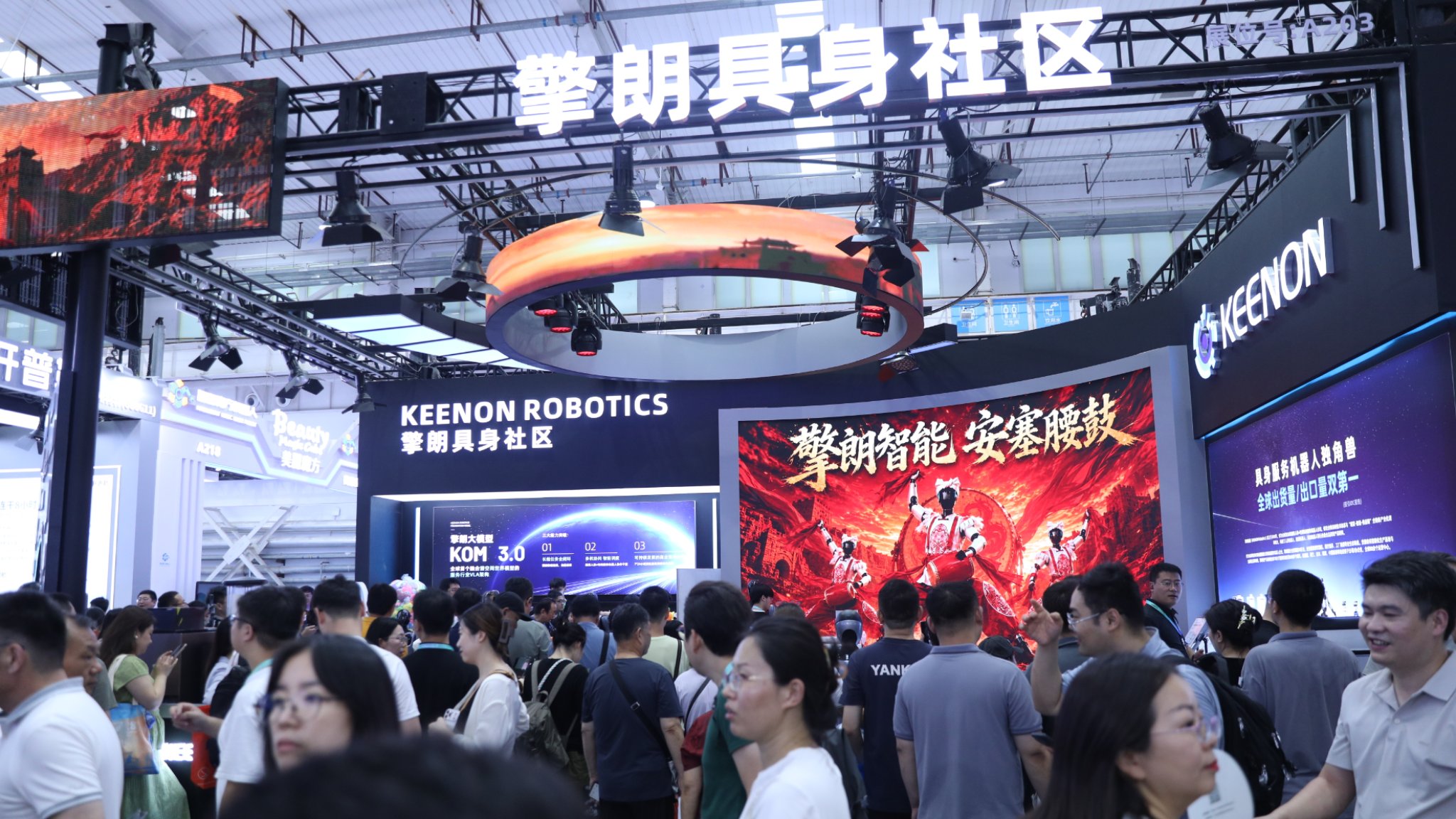
With the launch of this year’s XMAN humanoihumanoid series, KEENON Robotics officially releases KOM 2.0 (KEENON Operator Model 2.0), the world’s first VLA model specifically designed for the service industry. KOM 2.0 sets a new Industrial standard for embodied intelligence, enabling robots to perceive, understand, and act in complex real-world service scenarios.
At its core, KOM 2.0 combines the K-Mind System (Thinking System) for high-level task planning with the K-Act System (Action System) for precise motion execution. The K-Mind System, powered by a VLM-based multimodal large model and leveraging K-Infinity Contextual Learning, allows robots to sense environments, interpret tasks, and make intelligent decisions. The K-Act System, trained on extensive real-robot cases, produces smooth and reliable actions. Together, these systems provide a robust foundation for the next generation of KEENON robots.
Building on KOM 2.0, KEENON takes a pioneering step with the “Role-Oriented” concept, bringing it to life through the KEENON ProS specialized vertical model. ProS is a deep, domain-specific model tailored to particular service roles, boosting the applicability and efficiency of general-purpose robots in vertical scenarios. This allows robots to master tasks across restaurants, hotels, and retail environments, enabling rapid deployment of role-specific expertise.

K-Mind System & K-Act System: Thinking and Acting in Harmony
KOM 2.0’s dual-system design mirrors human cognition:
- K-Mind System: High-level thinking, understands complex environments, interprets natural language, and plans complex strategies.
- K-Act System: Executes precise, continuous motions guided by K-Mind and the robot’s current state, trained on extensive real-robot cases.
By thinking and acting asynchronously, KOM 2.0 achieves both intelligent decision-making and agile execution, ensuring reliable task planning while maintaining fluid, human-like performance.

K-Infinity Contextual Learning: Scene-Driven Service Specialization
KOM 2.0’s capabilities stem from hundreds of millions of real-world service interactions, collected from KEENON robots operating in live environments. This is built upon KEENON’s proprietary multi-modal perception and environment reconstruction technology, which enables the creation of highly realistic digital service scenarios. By conducting physical simulation interactions in these digital scenarios, a solid foundation is laid for the training and evolution of the KOM model.
Through the K-Infinity Contextual Learning set—constructed on this basis and characterized by strong authenticity, diversity, and business relevance—robots interact, learn, and evolve within real-world scenarios, acquiring authentic, diverse, and business-relevant knowledge. It provides robust support for the model’s robustness and generalization ability.
This forms a continuous learning loop—scenario experience, model evolution, deployment, feedback, and optimization—creating a self-reinforcing flywheel effect that accelerates model evolution. As a result, KOM 2.0 adapts broadly and demonstrates exceptional resilience in commercial service environments, including high-frequency interactions, unexpected disturbances, and dynamic changes.

KOM 2.0 Model: Toward a More Universal Future for Embodied Service Robots
- Deeper Environmental Cognition: Breaks traditional recognition limits to achieve perception from objects to intentions, behavior prediction, and scene semantic reconstruction—truly enabling robots to perceive, understand, and act.
- Faster Real-Time Decision Making: Millisecond-level response handles dynamic obstacles, ad hoc tasks, and multi-robot coordination, ensuring smooth and reliable operational loops.
- More Human-Like Interaction: Supports safe, anthropomorphic movements and precise execution, improving user experience and making robots more attentive and dependable partners.
- Efficient Scalable Deployment: Strong adaptability reduces scene customization and manual tuning, enabling rapid replication, flexible scaling, and smooth commercial rollout.
KEENON ProS: Making Embodied Service Robots More Professional
Leveraging deep insights into vertical industries, KEENON extends KOM 2.0 with a role-oriented strategy, embedding role-specific knowledge and fine-tuning models with industry knowledge graphs. The ProS vertical model covers multiple scenarios such as dining, hotels, healthcare, and retail, including roles like cashier, food runner, and front desk. ProS embodies KEENON’s industry intelligence and commercial value.
By integrating a multi-type, role-specific robot portfolio, KEENON enables cross-scenario task transfer and generalization, shortening deployment cycles and reducing startup costs. Core advantages include:
- Preloaded expert capabilities for specific roles, delivering efficiency, precision, and stability.
- Deep scenario penetration for handling dynamic, unstructured tasks, with multi-robot collaboration completing full operational workflows.
- Rapid deployment and high-efficiency operations for customers, supporting scalable business rollout.

The launch of KOM 2.0 represents a leap forward in robotic intelligence, allowing robots to perceive, understand, and act with precision in real-world service scenarios. KEENON Robotics will continue to advance its multi-modal robot portfolio, comprising both general-purpose and role-specific robots, enhancing their multimodal intelligence capabilities and collaborating with global partners to scale embodied intelligence technology worldwide.